Natural enough to publish: an AI voice you can actually use
Most AI voices sound great in a ten-second demo and fall apart over twenty minutes. Here is how we measure naturalness, and what it takes to ship a cloned voice you would put your name on.

Almost every voice AI can pass a ten-second demo. The clip sounds clean, the words are clear, and for about two sentences you believe it. Then you try to narrate a real script, a chapter, a course module, a twenty-minute video, and the illusion cracks. The endings flatten, every sentence lands with the same shape, and somewhere around minute three your ear stops hearing a person and starts hearing a machine reading.
That gap, between a good demo and a narration you can publish, is the only thing that matters. Vocast was built to close it, and to prove it closed with numbers rather than adjectives.
“Natural” is not clarity. It is prosody.
When people say an AI voice sounds robotic, they rarely mean it is hard to understand. Modern text-to-speech is almost always intelligible. What they react to is prosody: the rise and fall of pitch, where the breaths land, how a sentence slows into its final word, which syllables get pushed and which get swallowed. Prosody is what makes a voice sound like it is thinking, not reciting.
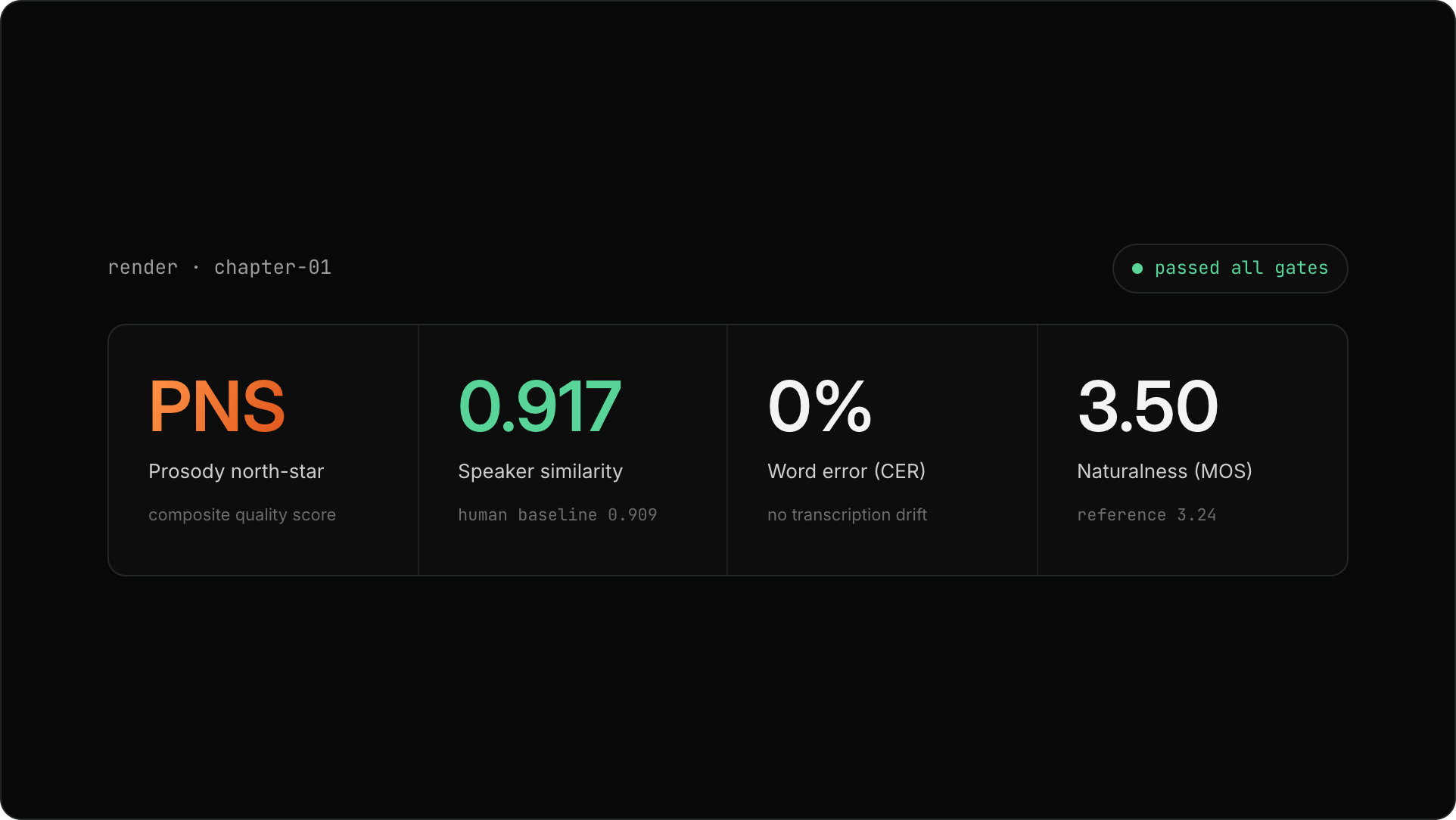
So that is what Vocast measures first. Its north-star metric is a prosody naturalness score (PNS), a single number, benchmarked against how a real person reads the same lines.
Where a voice actually breaks
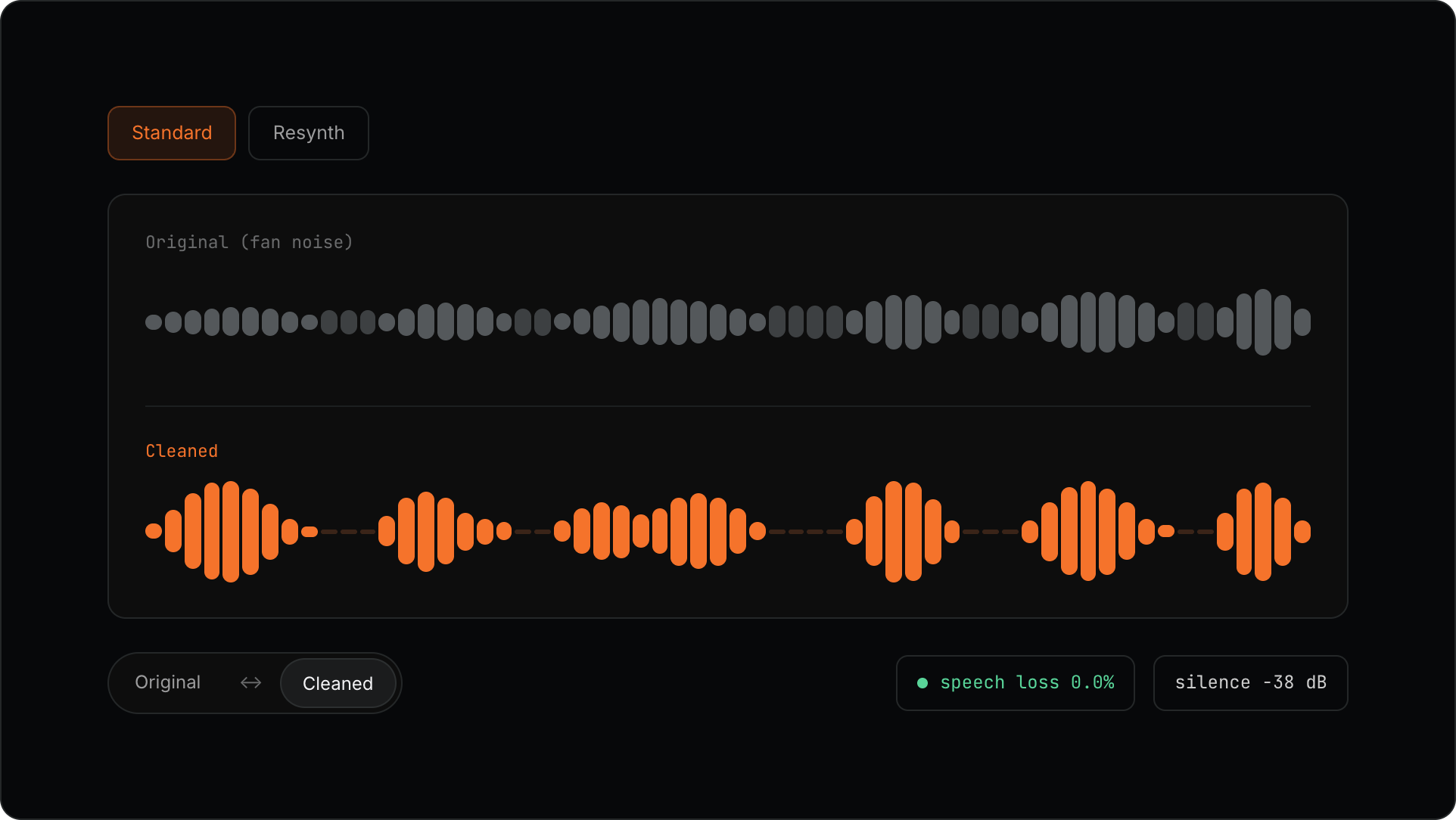
Long-form failure is not one bug, it is four, and none of them are visible in a short clip. They only surface once the voice has to keep going:
- Pitch collapse. The melody narrows paragraph by paragraph until the voice is reading on a flat line. The first sentence has range; the fortieth does not.
- Metronomic cadence. Pauses stop landing on meaning and start landing on a timer, so every sentence takes the same beat and the rhythm turns mechanical.
- Boundary breathing. The tiny breath and settle between sentences disappears, and clauses run into each other with no room to think.
- Clipped endings. Final words get chopped or dropped to an identical hard stop, instead of decaying the way a person trails off.
Each of these has its own named metric in Vocast and its own gate, so a render cannot pass by being good on average while quietly failing one of them.
The numbers, not the vibes
Vocast scores every render on four axes, and gates on all of them:
- Speaker similarity (SIM): our winning configuration lands between 0.917 and 0.945. Two recordings of the same real person score about 0.909 against each other, so the clone sits inside the range of your own voice on two different days.
- Word accuracy (CER): the audio is transcribed back and compared to the script. On mixed scripts with numbers and loanwords, character error rate is 0%.
- Naturalness (MOS): a no-reference model rates the clone at 3.50, slightly above the 3.24 reference it was cloned from.
- Prosody (PNS): the north-star, held to a human-baseline gate on every take.
None of these are cherry-picked. They are enforced in continuous integration, and a render that misses a gate is rejected, not shipped. Calling a voice from an agent looks like clone_voice(text, profile_id="MyVoice"), and it returns the score with the audio.
The honest version of “it sounds natural” is: we defined natural as a set of measurable properties, and then refused to ship anything that missed them.
So, can you actually use it?
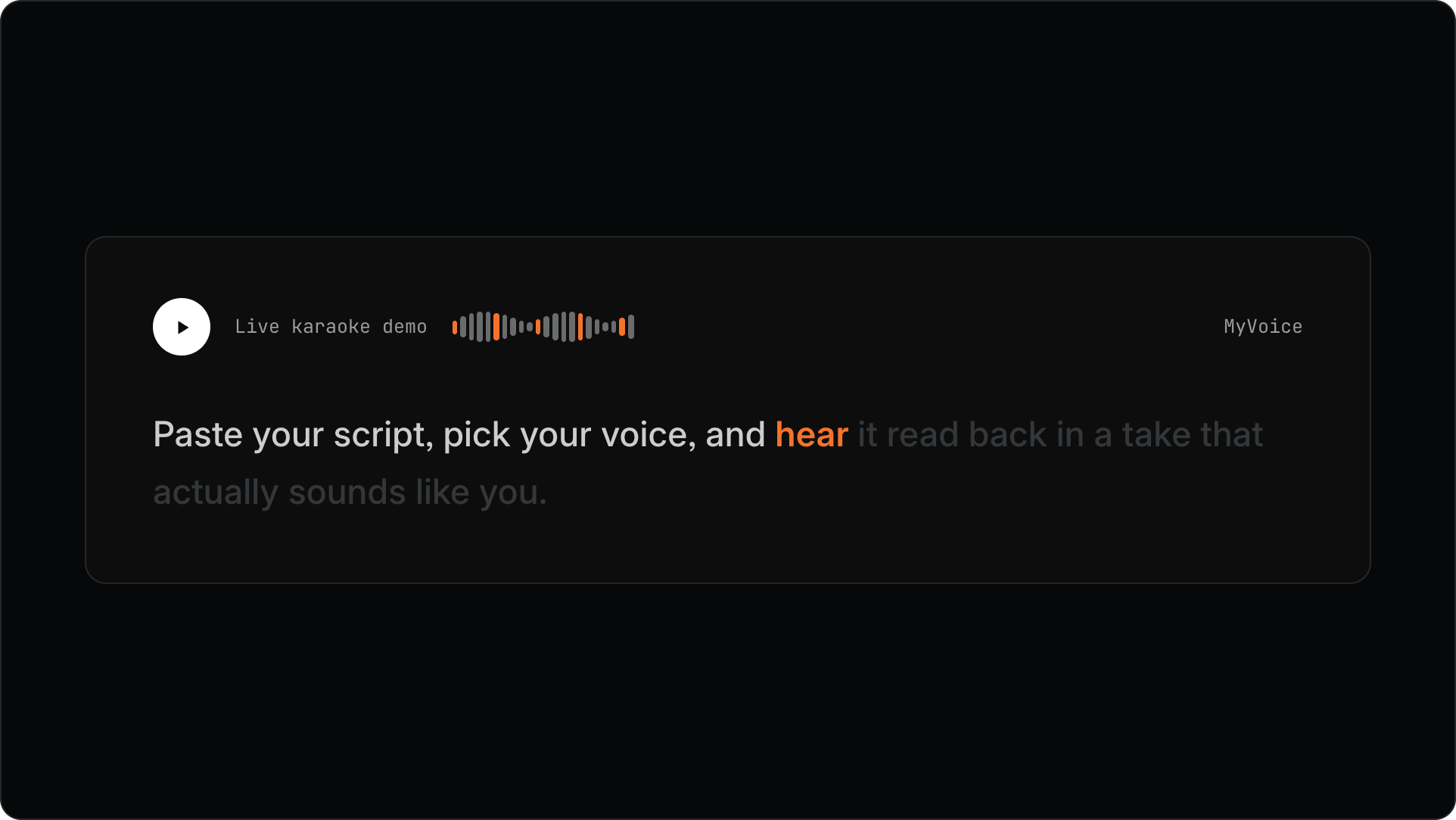
Generation runs at roughly 4× realtime on an Apple Silicon Mac, entirely on the machine. No upload, no queue, no per-minute meter. A karaoke view colours each word as it plays so you proof a long narration by eye and ear at once. And when one paragraph comes out flat, you regenerate just that block instead of re-rendering the whole take.
It is not a voice that fools you for ten seconds. It is a voice you can put on a twenty-minute video, in your own name.